The Tool & Leaf
The ladle and the bucket. Small tools, big role
Why the simplest sauna tools matter more than people expect.
17 October 2026
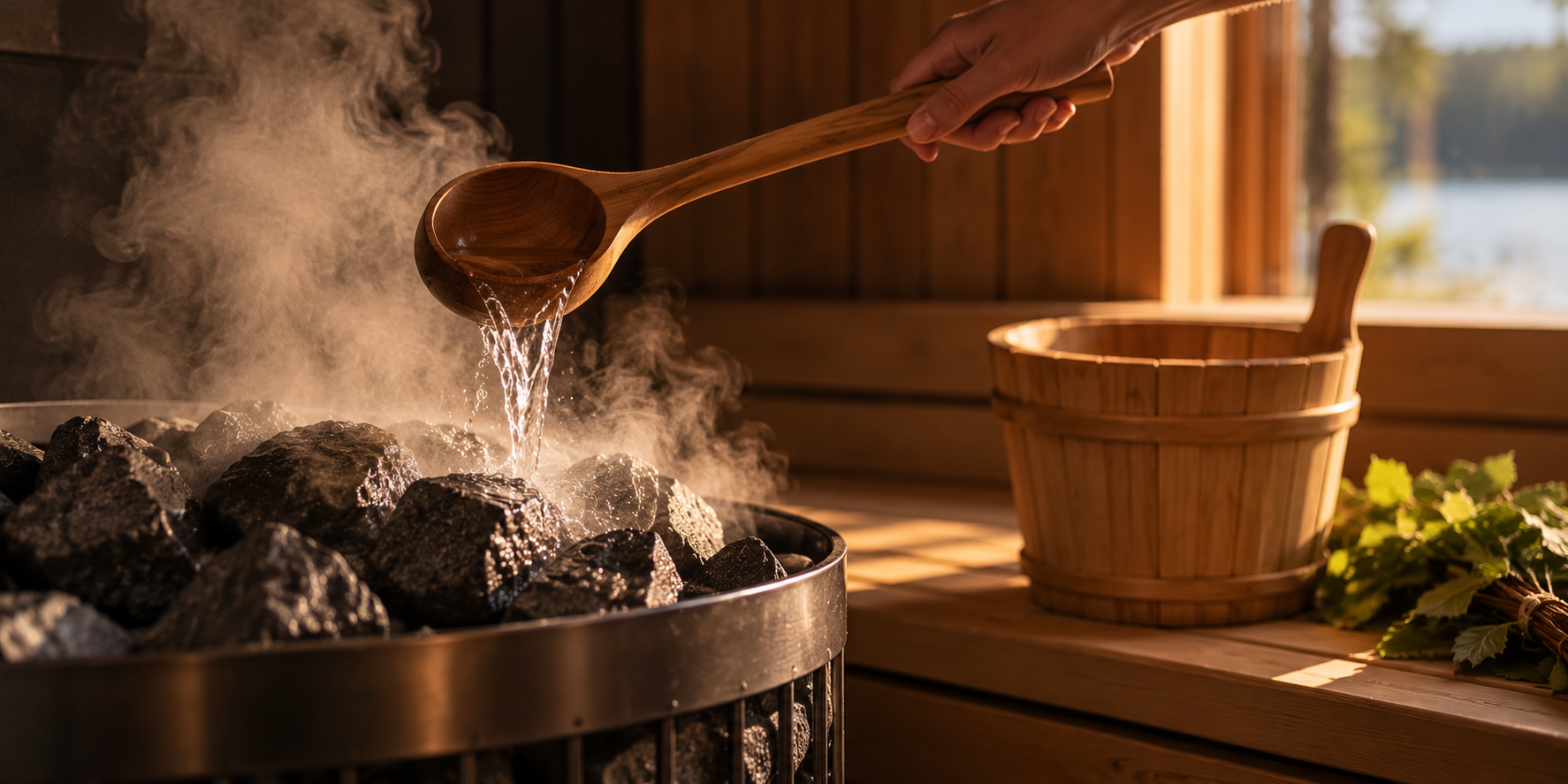
The ladle controls all of it. A small pour gives a gentle waft of steam. A generous pour gives a wall of heat that pushes everyone back on the bench. The size of the ladle, the speed of the pour, the angle you throw it at the stones, all of that is steamcraft, and none of it is possible without the tool doing exactly what it needs to do and nothing more.
How much water should go on per pour?
As a rule of thumb, start with half a ladle if you don’t know the room. You can always add more, but you can’t take steam back once it hits the stones. And there’s no fixed rhythm to follow. A common approach is one modest pour every few minutes, letting the steam clear before the next, rather than pouring continuously. A typical session uses a few ladles per round, not liters at a time. Too much water at once cools the stones, and the stove then needs time to recover. Gentle, repeated löyly feels better than one big blast.
Water temperature changes the effect too. Cold water gives a sharper, more intense hiss and burst of steam, though it also cools the stones more and can make them spit. Room temperature water gives something gentler and more even, and it’s the easier choice for a home sauna. Very hot water barely changes anything. It just removes the contrast that makes the pour interesting in the first place.
Why wood, and why it still matters?
Most traditional ladles and buckets are wood, usually cedar, aspen, or pine. Not because tradition demands it, but because wood behaves correctly in a sauna. It doesn’t get hot to the touch the way metal does. It doesn’t sweat or corrode the way certain plastics do over years of heat cycling. It holds water without imparting a smell, and it ages into the room rather than sitting apart from it. Many wooden buckets also come with a removable plastic or stainless insert, which keeps the wood from leaking and makes cleaning much easier.
Does the species of wood actually matter?
Practically, not hugely for performance. Cedar, aspen, and pine all function fine. The real differences are aroma (cedar and pine give off a mild scent when warm and damp), durability, and personal taste.
There’s also a quieter reason wood wins out. It dampens sound. A metal bucket knocking against a bench rings through a quiet sauna. A wooden one barely registers. In a space built around stillness, that’s not a small thing.
What kinds of ladle are there?
The traditional choice is the all-wood ladle, the Finnish kauha. It feels natural, stays comfortable in the hand, and suits a purist sauna. Its one downside is that wood absorbs oils and fragrance, so it’s hard to keep neutral if you use aromas.
The other common type has a wooden handle with a copper or stainless steel bowl. It’s durable, easy to clean, and doesn’t absorb scent, which usually makes it the best choice for aromatherapy. The handle matters most here. It should be long enough, and attached so that the metal doesn’t carry heat into your grip.
Bowl shape changes the pour too. A deep bowl holds roughly 2 to 3 dl and gives a stronger, more concentrated löyly. A wider, shallower bowl spreads the water over the stones for softer, more even steam. As for handle length, about 40 to 60 cm suits most home heaters, and longer handles suit larger stoves, because your hand stays clear of the steam.
The bucket as a small act of hospitality.
The bucket does more than hold water. Filled and placed before guests arrive, it’s a quiet signal that someone thought about this session before it started. An empty or dry bucket, by contrast, tells you the opposite. That the sauna is a room, not an experience someone is looking after.
Size matters more than you’d think. For a home sauna, 5 to 8 liters is the sweet spot: big enough for a full session, small enough to carry, and not too heavy once filled. Public and group saunas often use 8 to 10 liters or more. Bigger isn’t better, though, because an oversized bucket tends to sit with old water for days. Fill it about two-thirds full, which leaves room for the ladle and keeps it from spilling when you carry it. You won’t use all of it, and that’s fine.
Use fresh water every time. Warm water standing for hours in a heated room is an ideal place for bacteria and biofilm to grow, especially if oils have been added.
Fill the bucket before each session, empty it when you’re done, and never leave water standing between sessions.
This is where the small tools stop being about function and start being about care. Anyone who has sat in a good guesthouse sauna knows the feeling of a full bucket and a ladle that’s the right weight in your hand versus a plastic scoop that feels like an afterthought. The stones can be the same, the stove can be identical, and the sauna will still feel worse with the wrong tools.
What “the right tool” actually means?
It’s not about buying the most expensive ladle available. A well made one is simple. It holds enough water to matter without dumping so much that it shocks the stove, it’s balanced enough that a full ladle doesn’t strain your wrist, and it doesn’t leak or splinter after a season of heat and moisture. That’s it. The bar is low, but a lot of ladles sold today don’t clear it.
The same goes for the bucket. It needs to hold water without leaking, sit steadily on a bench or hook without tipping, and survive being repeatedly filled with cold water and left in a hot room. Simple requirements, but the gap between a bucket that meets them and one that doesn’t shows up the first time you use it.
The details are where good sets and merely pretty ones part ways. Wood should be wherever your hand touches, so handles, grips and rims shouldn’t be metal. Any metal, such as a bowl, screws or rivets, should be kept well away from the grip, and the handle should be long enough to keep your hand out of the steam. Hooks and storage belong away from the heater. And above all, tools should be tested in a real, hot sauna, not on a showroom table.
A personal note
I learned this the hard way. I’ve burned myself on sauna tools more than once, including products from well-known brands and buckets and handles in wellness spas that used metal. It’s a small burn, but a bad start to a session. Getting it right isn’t difficult. It takes someone who has actually used a sauna while designing the product.
Keeping them that way is mostly about habit, not effort. Rinse both after use and let them air-dry fully between sessions, upside down or hung up with air circulating, rather than storing them wet. Skip soap. It can soak into the wood and taint the water later. If a bucket starts leaking or the wood keeps cracking, it’s usually because it’s drying out too much between uses. A light occasional oiling and keeping it slightly humid rather than bone dry helps it last for years.
Oils and aromatherapy
A lot of people also like adding a scent to the water (commonly birch, eucalyptus, tar, mint, pine or spruce). A few drops per ladle-full is plenty. Heat strongly intensifies scent, and too much leaves a sticky residue on the stones over time. Try one scent at a time so you can tell what you like.
Never pour pure essential oils directly onto the stones or stove. They can flash, smoke, and damage the stones, and the smell is overwhelming. Dilute them in water, and use sauna-specific aromas where you can, since they’re made for exactly this. It’s also worth checking your stove’s instructions, as some manufacturers advise against oils or specify how to use them.
Because oils soak into wood and flavor every later session, keep scented water separate. A small dedicated aroma container with its own ladle, ideally one with a metal bowl, keeps your main bucket neutral.
Small tools, big role.
There’s a pattern in sauna culture worth noticing. The things people spend the most money on, the stove, the stones, the benches, are rarely what make a session memorable. What people remember is the feel of the steam, the weight of the ladle in hand, whether the water was warm or shockingly cold, whether someone had clearly filled the bucket before they arrived.
And in shared or public saunas, there’s often an unspoken courtesy around all of this. It’s polite to ask before pouring, since not everyone in the room wants the same intensity of steam. The same goes for scent, as strong aromas can bother other bathers, especially people with allergies or asthma.
The ladle and the bucket are unglamorous by design. They don’t heat anything, they don’t hold up a roof, they don’t determine the building’s insulation rating. But they’re the interface between a person and the heat.