The Unfiltered View
The difference between a "Wellness Sauna" and a Real One
When a sauna is just another facility, something essential gets lost.
10 October 2026
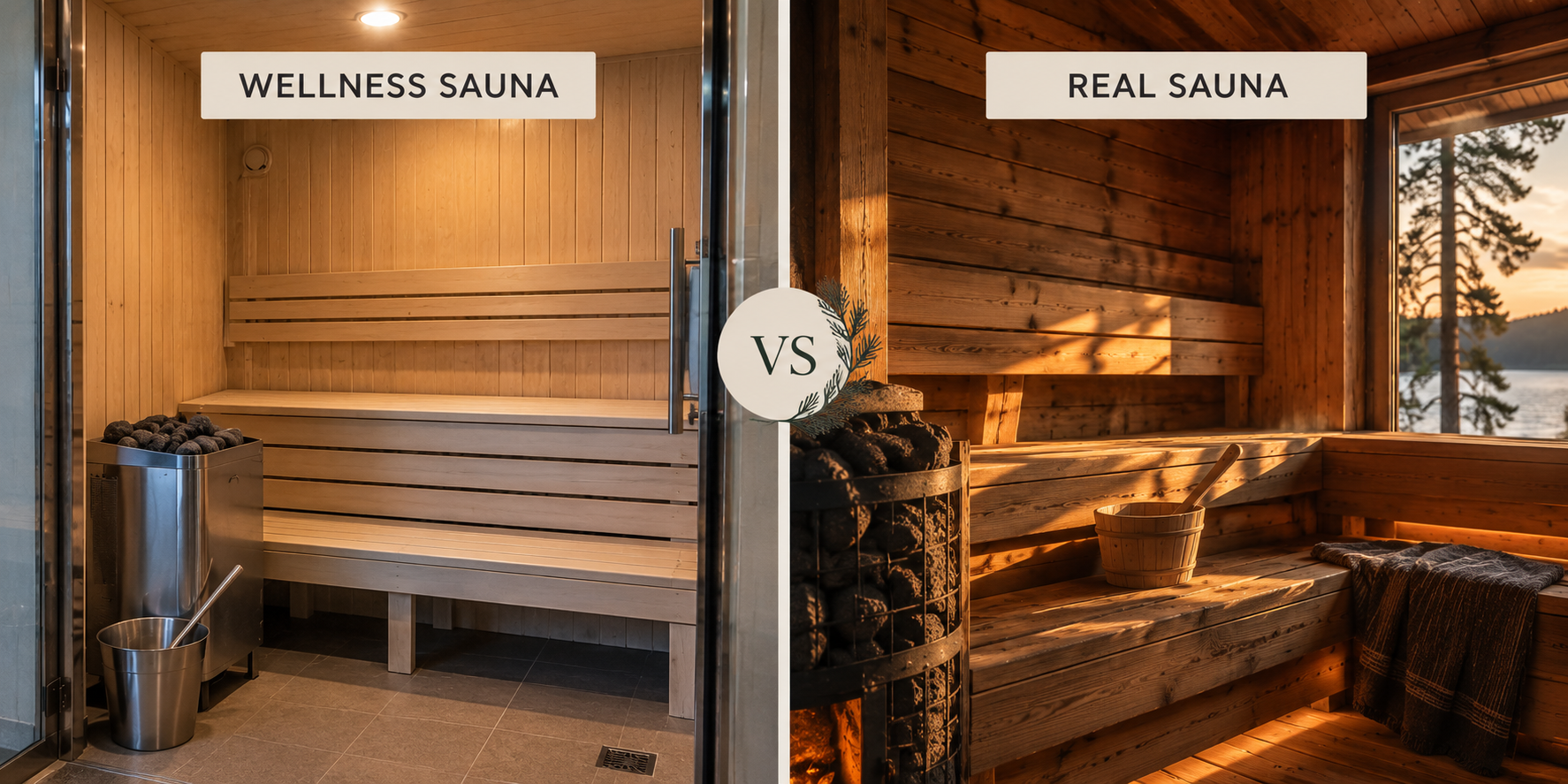
Let me start by clarifying what I mean by a “wellness sauna,” because the term gets used loosely.
A wellness sauna is a sauna that exists as an add-on. It’s the room tucked into the corner of a hotel gym, the cabin next to the changing rooms, the “spa area” that is really a gym with a few extra amenities. Nobody built the space around it. It was added to a list of facilities, so the brochure can say “sauna” and the booking page can say “wellness.”
That is the core of the problem. In a wellness sauna, the sauna is one feature among many. In a real sauna environment, it is the reason everyone is there.
Where the attention goes, and where it doesn’t?
You can usually feel within a minute whether anyone cared about the sauna. In my experience, wellness saunas tend to be weak in the basics:
Poor materials. Thin panels, cheap finishes, benches that feel more like furniture than part of a room built for heat.
A token heater. Small, underpowered, with too few stones to hold any real heat.
The metal bucket and ladle. If there is a bucket at all, it is usually metal, and the ladle is metal too. Try to use it and you burn your hand. Nobody who understood how a sauna is used would have chosen it.
A heater that can’t keep up. The door opens every few minutes as people drift in and out, and the heat never gets a chance to build or settle.
That last point matters more than it sounds. A sauna holds its heat only if it is treated as a sacred space: door closed, people staying a while, a steady rhythm. A wellness sauna is a place of several activities, and the sauna is just one of them. People use it for five minutes between the gym and the shower, or while waiting for someone. The room never gets the chance to become what it is supposed to be.
I’m not against wellness saunas existing. A warm room is better than no sauna at all, and for some people it is a first step. But if that is the only kind you have experienced, you may not yet know what a sauna can be.
The placement problem.
Then there is where these saunas are built. I have seen them in spots that make no sense: right inside the changing room, with the relaxation area in the middle of it, a hotel gym with people chatting loudly, towels, lockers and general traffic around the door.
Calling that a “wellness” area is almost funny. Wellness implies quiet, calm, space to slow down. You cannot have that in a corridor next to the lockers. And I would go further: in a real sauna culture there should never be a “wellness corner.” A sauna is not something you squeeze into a corner. It deserves its own space, its own atmosphere and its own silence.
It is very hard to find a good wellness sauna.
This is the uncomfortable truth: a good sauna is difficult to find unless you go to a place where saunas are the whole point.
I mean a spa or relaxation area where saunas are the main goal. No pool dominating the space, no bar, no busy social scene. Just saunas, the cooling spaces that go with them, and quiet places to rest. People come there to experience the sauna itself, and everything around it is built to support that. The staff understand it, the design reflects it and the guests behave accordingly.
In those places, you can feel the difference immediately. The heat is steady. The wood is good. The stove has enough stones and enough power, and you can throw water and feel the löyly roll over you. The room is quiet, because everyone is there for the same reason.